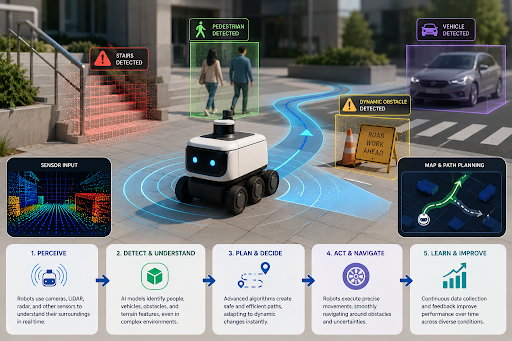
As robotics technology becomes more advanced, businesses across industries are deploying autonomous robots to improve operational efficiency, automate repetitive tasks, and support large-scale operations. From warehouses and hospitals to commercial facilities and security environments, robotics is becoming a major part of modern business infrastructure.
However, while robots perform well in controlled environments, real-world navigation remains one of the biggest challenges in robotics deployment. Dynamic surroundings, unpredictable obstacles, and human interaction often create situations that autonomous systems cannot fully manage on their own.
This is why many organizations are integrating robot teleoperation and robot monitoring services to support robotic navigation with real-time human oversight and operational assistance.
Why Navigation Is One of the Biggest Challenges in Robotics
Robots rely on sensors, mapping systems, cameras, artificial intelligence, and machine learning algorithms to navigate environments autonomously. While these technologies continue improving, real-world conditions remain highly unpredictable.
Robotic systems may encounter:
- Crowded walkways and workspaces
- Unexpected obstacles or moving objects
- Changing layouts and environments
- Poor lighting or weather conditions
- Human behavior that is difficult to predict
Even advanced robotics systems can struggle when situations fall outside their programmed scenarios or training data.
Common Real-World Navigation Problems
As robotics deployments expand, companies face several navigation-related operational challenges.
1. Dynamic Environments
Warehouses, hospitals, retail spaces, and commercial buildings constantly change throughout the day. Inventory movement, customer traffic, and operational activity can disrupt robotic pathways.
2. Sensor Limitations
Robots depend heavily on sensors and cameras to interpret their surroundings. Dust, lighting changes, reflective surfaces, or environmental interference can reduce accuracy.
3. Edge Cases & Unexpected Situations
Robots may struggle with situations they were not specifically trained to handle, such as:
- Sudden obstacles
- Emergencies
- Human crowding
- Blocked pathways
- Unusual object placements
4. Multi-Robot Coordination
Large robotic fleets operating simultaneously can create navigation conflicts, traffic bottlenecks, and operational slowdowns.
Without proper oversight, these issues can affect efficiency, safety, and operational reliability.
How Robot Monitoring Helps Solve Navigation Challenges
To improve reliability, many robotics companies now use remote monitoring and teleoperation systems that allow trained operators to supervise robots in real time.
Using:
- Live camera feeds
- Sensor and GPS data
- Operational dashboards
- Remote control interfaces
- Real-time alerts and communication systems
Operators can quickly intervene when robots encounter navigation difficulties.
This human-in-the-loop approach allows businesses to:
- Resolve navigation issues faster
- Improve operational safety
- Reduce downtime and workflow interruptions
- Support robots in unpredictable environments
- Maintain more reliable autonomous operations
Instead of relying entirely on automation, organizations combine machine efficiency with human expertise to create more adaptable robotic systems.
Businesses exploring scalable robotics support solutions often also rely on services available through the OBI Services homepage.
Benefits of Human-Supported Robot Navigation
Combining robotics with remote operational support provides several advantages for businesses deploying autonomous systems.
Improved Operational Reliability
Human operators help robots adapt to real-world environmental changes more effectively.
Faster Problem Resolution
Navigation issues can be resolved immediately before they disrupt workflows.
Better Safety Management
Remote oversight helps reduce risks in crowded or high-traffic environments.
Reduced Downtime
Monitoring teams can quickly respond to technical or environmental interruptions.
Scalable Fleet Operations
Centralized monitoring allows businesses to manage larger robotic deployments across multiple locations efficiently.
Industries Facing Navigation Challenges
Many industries deploying autonomous robotics benefit from remote monitoring and teleoperation support.
Warehousing & Logistics
Warehouse robots navigate constantly changing inventory layouts and high-traffic environments.
Healthcare Facilities
Hospital robots must safely move through crowded hallways and sensitive medical environments.
Security & Surveillance
Patrol robots monitor large facilities while adapting to unpredictable human activity.
Hospitality & Retail
Customer-facing robots operate in dynamic commercial spaces where navigation accuracy directly affects customer experience.
In each industry, combining automation with human oversight improves robotic reliability and operational performance.
For more insights into robotics, automation, and operational support strategies, businesses can explore this related industry blog.
The Future of Autonomous Navigation
The future of robotics is not about fully eliminating human involvement—it is about creating smarter collaboration between autonomous systems and human expertise.
As robotics technology continues evolving, businesses that integrate human-in-the-loop monitoring systems will be better positioned to:
- Improve robotic performance
- Reduce navigation-related risks
- Scale autonomous operations safely
- Adapt to unpredictable environments
- Maintain higher operational efficiency
Real-world navigation will remain one of the most important challenges in robotics, and organizations that combine automation with real-time human support will lead the next generation of scalable robotic operations.